有刚入门的小白不知道numpy中如何使用mask,今天小编就来讲讲使用mask会遇到的一些问题。
numpy中矩阵选取子集或者以条件选取子集,用mask是一种很好的方法。
简单来说就是用bool类型的indice矩阵去选择。
mask = np.ones(X.shape[0], dtype=bool)
X[mask].shape
mask.shape
mask[indices[0]] = False
mask.shape
X[mask].shape
X[~mask].shape
(678, 2)
(678,)
(678,)
(675, 2)
(3, 2)
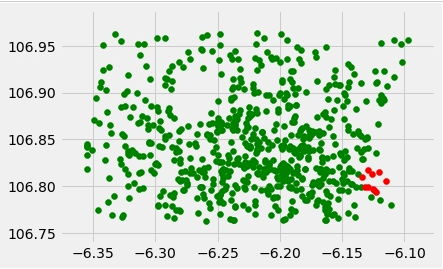
例如我们这里用来选取全部点中KNN选取的点以及所有剩余的点。
from sklearn.neighbors import NearestNeighbors
nbrs = NearestNeighbors(10).fit(X)
_,indices = nbrs.kneighbors(X)
mask = np.ones(X.shape[0], dtype=bool)
mask[indices[0]] = False
plt.scatter(X[mask][:,0],X[mask][:,1],c='g')
plt.scatter(X[~mask][:,0],X[~mask][:,1],c='r')
带条件选择替换,比如我们需要将a矩阵内某条件的行置换为888剩余置换为999,可以直接用mask或者再用where一步搞定:
mask = np.ones(a.shape,dtype=bool) #np.ones_like(a,dtype=bool)
mask[indices] = False
a[~mask] = 999
a[mask] = 888
#############
np.where(mask, 888, 999)
是不是很容易呢,小伙伴们学会了没有~更多Python学习推荐:PyThon学习网教学中心。